AI for teaching and student thinking
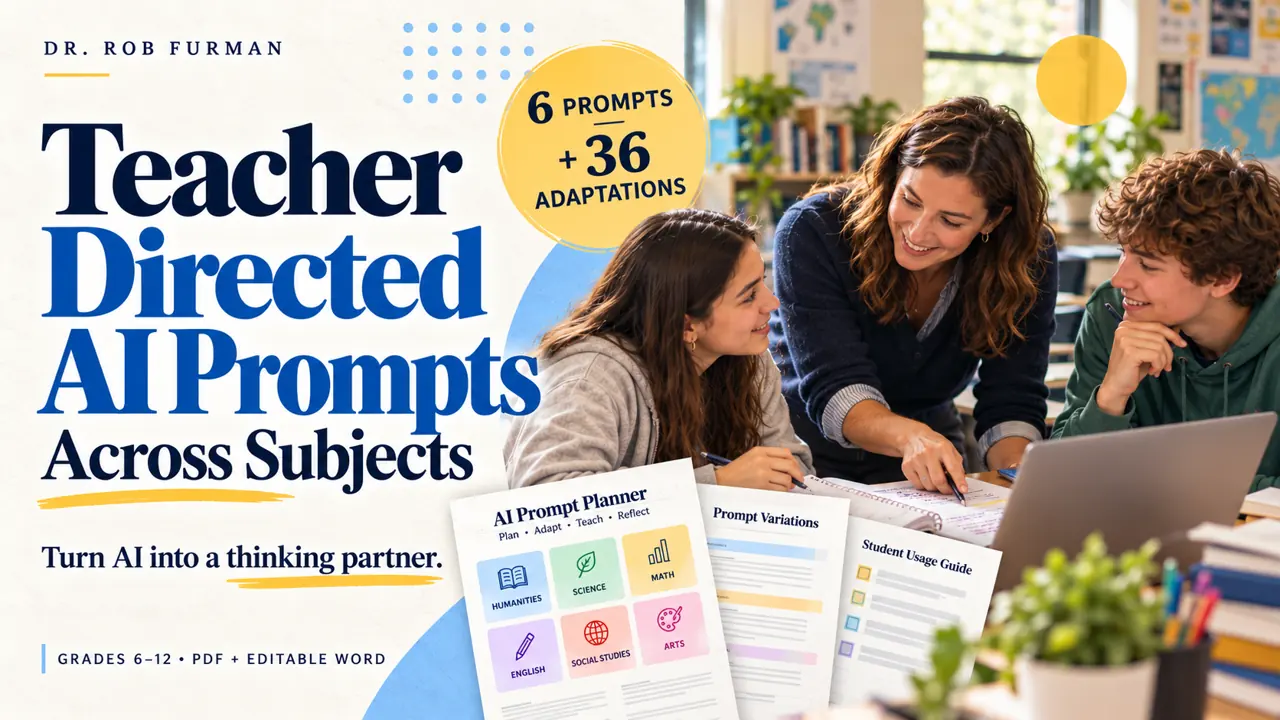
Teacher Directed AI Prompts Across Subjects
Give AI a useful job in your assignment while students practice explaining, questioning, and revising their own thinking.
Designed primarily for grades 6–12 · ELA, mathematics, science, social studies, music, and visual art
The idea
Start with a student's own thinking
Choose a familiar assignment and a clear learning goal. Students make their first attempt, use a teacher-provided prompt to examine it, check the challenge, and explain what they changed or defended. A student who rejects an AI suggestion with good reasons may be doing excellent work.
Six prompts with a purpose
- Challenge my argument
- Question my evidence
- Find the flaw
- Compare approaches
- Ask like an expert
- Help me reflect
What is inside the pack
- An 18-page printable PDF, editable Word master, and copyable text version
- A teacher quick start and shared setup to pair with each complete prompt
- Six complete prompts with learning goals, teacher checks, and evidence students share
- 36 adaptations: six for each of ELA, mathematics, science, social studies, music, and visual art
- A student assignment handout and reflection and decision record
- An illustrative worked mathematics example and editable teacher review rubric
Try a free sample
Challenge an argument
Replace the brackets, use a school-approved tool, and preview the interaction yourself before assigning it.
I am a student in [grade and subject]. My assignment is [task], and my argument is [paste my own draft or explanation]. Help me examine it without rewriting it. Offer one reasonable counterargument and ask one question about my evidence. Wait for my response before continuing. Do not invent facts, sources, or quotations. If I disagree, ask me to explain why. After three exchanges, ask me to write my own decision about what I will keep or change.
Look for: a supported response to a counterargument and a student's explanation of what they kept or changed.
Read the article and try two more free prompts →One assignment is enough to begin
Keep the initial work, relevant conversation, final response, and a brief student-written reflection. Use them to discuss the learning process. A prompt or transcript alone does not prove authorship.